Military Involvement & Police Militarization in Central America
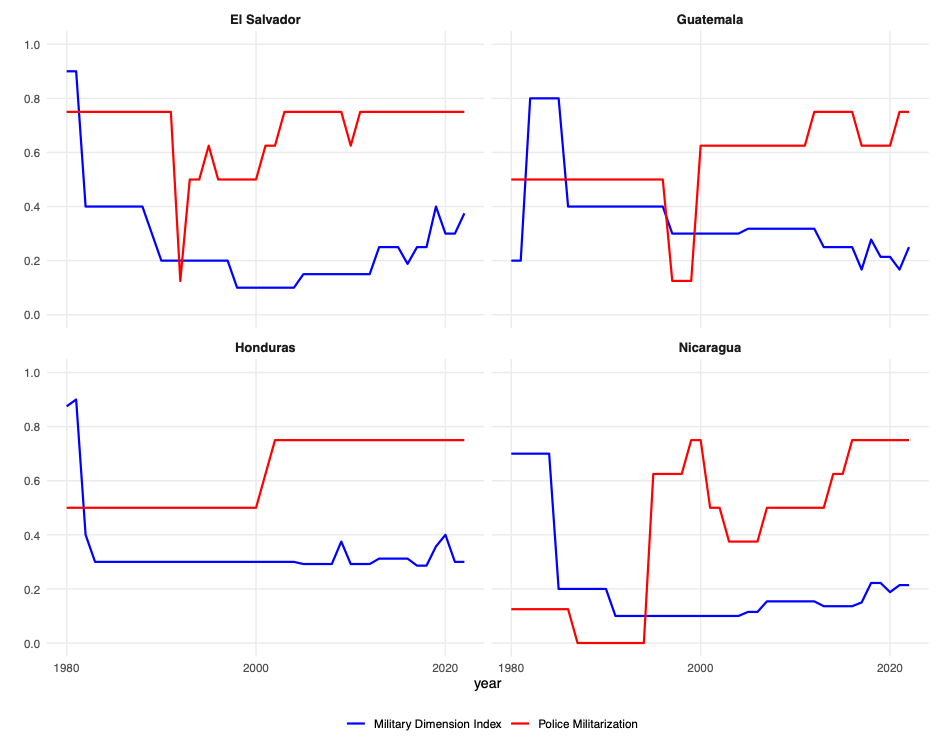
In this solo-authored study, I examine how military regime involvement and police militarization shape democratic trajectories in El Salvador, Guatemala, Honduras, and Nicaragua from 1980 to 2022. Using panel time-series analysis and qualitative case evidence, I analyze how different configurations of coercive authority affect democratic quality and political violence.
The findings show that military political involvement consistently predicts democratic decline and higher levels of state and non-state violence. Police militarization, by contrast, does not exhibit a uniform regional effect; its relationship with democratic outcomes varies across institutional contexts and elite strategies. The study demonstrates that military political power—rather than coercive capacity alone—poses the most consistent threat to democratic governance.
Research Assistant — Sportswashing & Social Identity (2023–2024)
Prepared and organized a dataset of over 700,000 tweets for a study examining how state-linked sports ownership affects public criticism of human rights abuses during Russia’s invasion of Ukraine. Using machine-learning classification and synthetic control methods, the published analysis shows that Chelsea F.C. supporters were less likely than other fans to discuss the invasion or criticize Russia after Roman Abramovich’s announcement to relinquish control of the club.
Published Article: State-Linked Sportswashing and Political Expression on Social Media (Social Science Quarterly) — https://onlinelibrary.wiley.com/doi/10.1111/ssqu.13485
Latino Political Attitudes
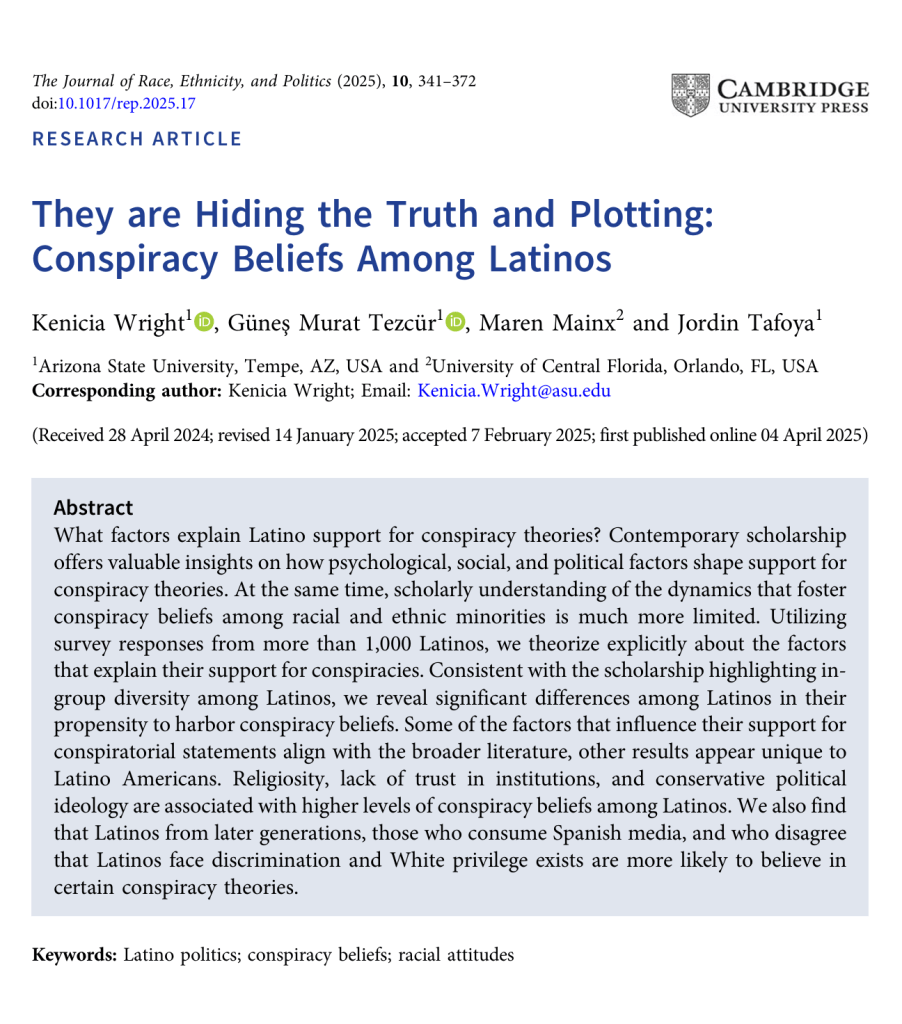
As a Graduate Research Assistant on an NSF-funded project, I contributed to a study examining political attitudes among Latino communities in the United States. In 2022, we conducted interviews and focus groups in English and Spanish, which informed the design of a nationally representative survey of more than 1,000 Latino respondents.
The resulting co-authored article, published in The Journal of Race, Ethnicity, and Politics (doi:10.1017/rep.2025.17), analyzes variation in Latino support for conspiracy theories. The study finds that religiosity, institutional distrust, conservative ideology, generational status, Spanish-language media consumption, and perceptions of discrimination are important predictors of conspiracy beliefs—while also revealing substantial heterogeneity within Latino communities.
Funding for this research was awarded by the Quality, Study, and Teaching (QSL) Commission at Hochschule Fulda University of Applied Sciences, Germany.
Costa Rica
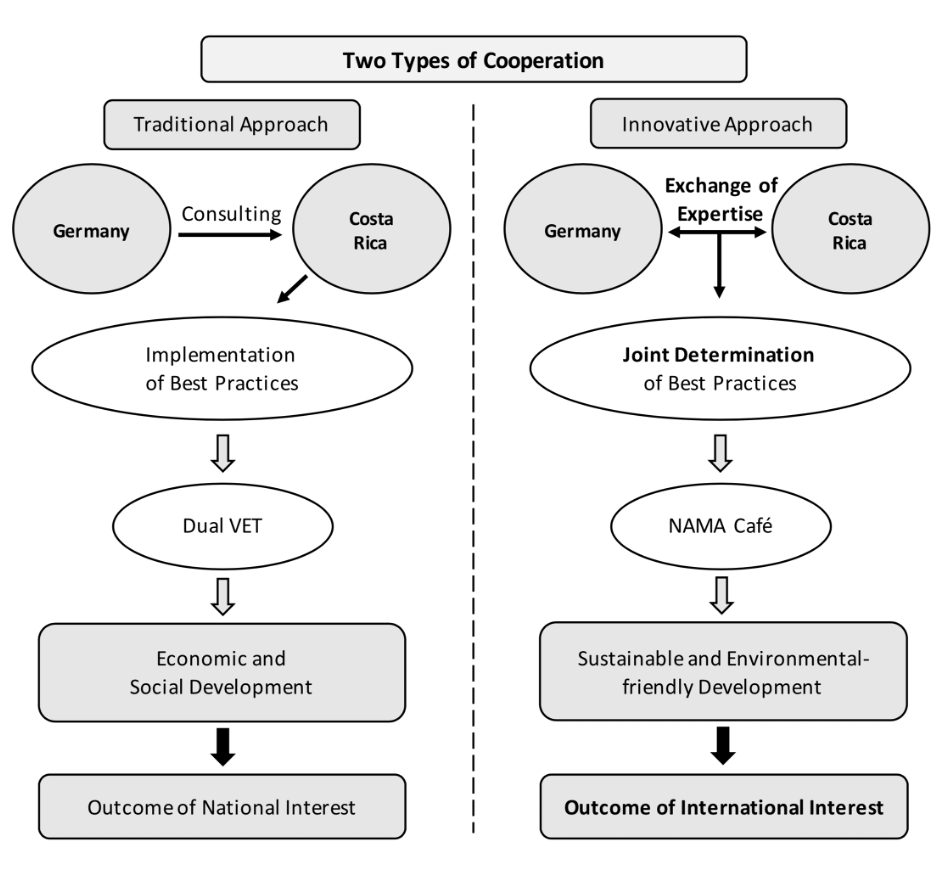
My interest in Latin America dates to 2018, when I conducted a case study on German-Costa Rican cooperation for my master’s thesis Climate Change and Development Policy: A Case Study on German-Costa Rican Cooperation. To gather original data, I undertook a research trip to San José, Costa Rica.
During this fieldwork, I conducted 22 semi-structured interviews with a representative cross-section of government officials, educational leaders, and civil society actors. Interviewees included the Costa Rican Ministers of Environment and Energy and of Education (2014–2018), the German Ambassador to Costa Rica (2014–2018), the Embassy Counsellor at the German Embassy, and a former Costa Rican Ambassador to Germany. These interviews provided firsthand insight into bilateral climate and development cooperation, institutional coordination, and transnational policy implementation.
 marenmainx.com