From Spring 2024 to Summer 2025, I worked as a Graduate Student Research Assistants/ Lab Managers at Hamilton College’s Policing Lab under the supervision of Prof. Erica De Bruin. In this role, I helped compile the Global Police Militarization Dataset (GPMD), which tracks national police organizational structures from 1946 to the present. I also mentored and provided feedback to undergraduate researchers contributing to the dataset.
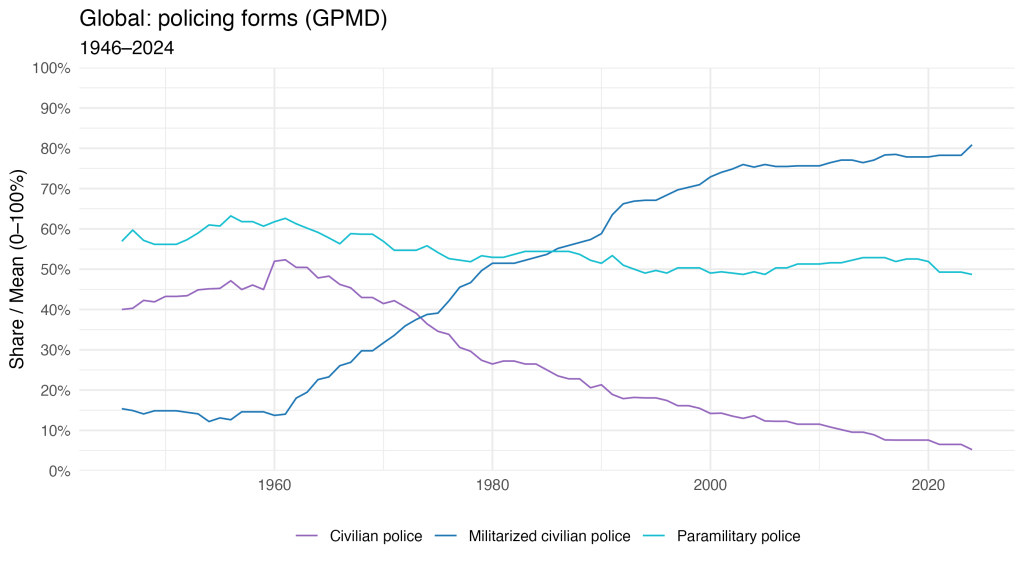
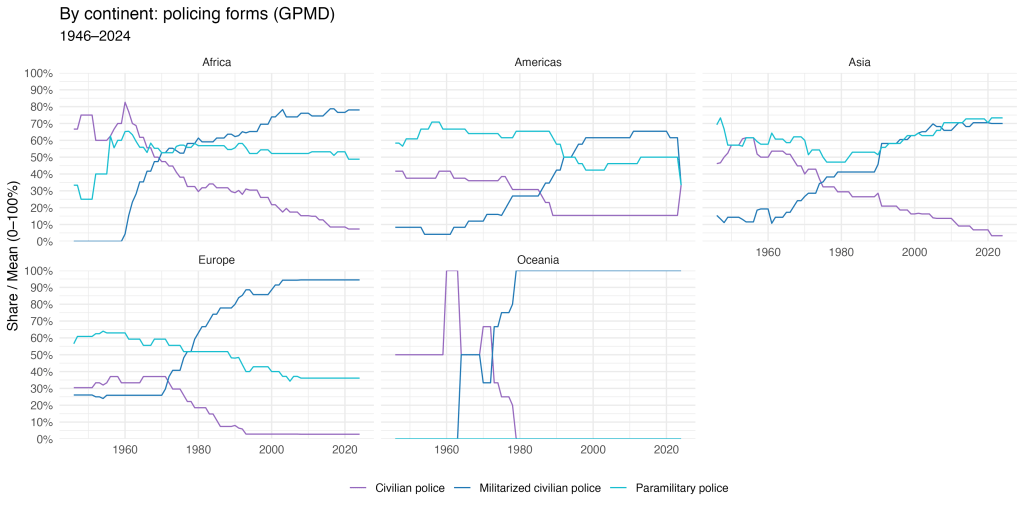
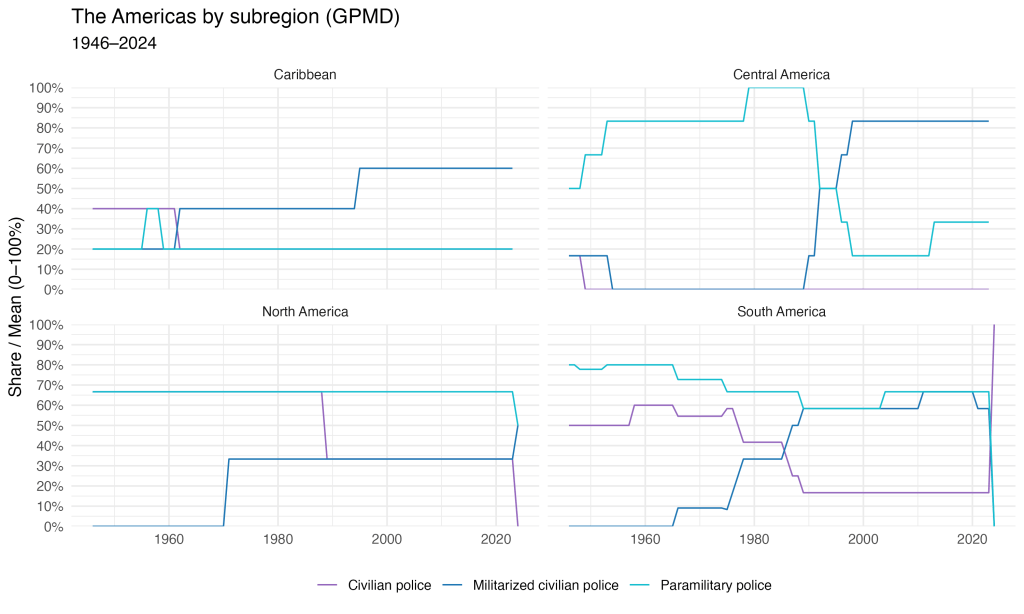
The graphs on the left use data from the GPMD. The dataset conceptualizes police militarization as a continuum and identifies three types of national-level policing systems. Because some countries operate mixed systems, they may fall into more than one category. The data capture federal-level police forces only (not local police).
Civilian Police
Accountable to civilian authorities, with less hierarchical command structures and limited access to military-grade weapons. This represents the least militarized form of policing.
Militarized Civilian Police
Primarily civilian forces that have adopted militarized elements, such as specialized tactical units (e.g., SWAT or riot squads) with military-style training and equipment.
Paramilitary Police
Forces organized along military lines, with centralized command structures, deployment in large units, and full access to military-grade weaponry. Some report directly to military authorities.
For more information, please visit https://www.hamiltonpolicinglab.com/.
 marenmainx.com